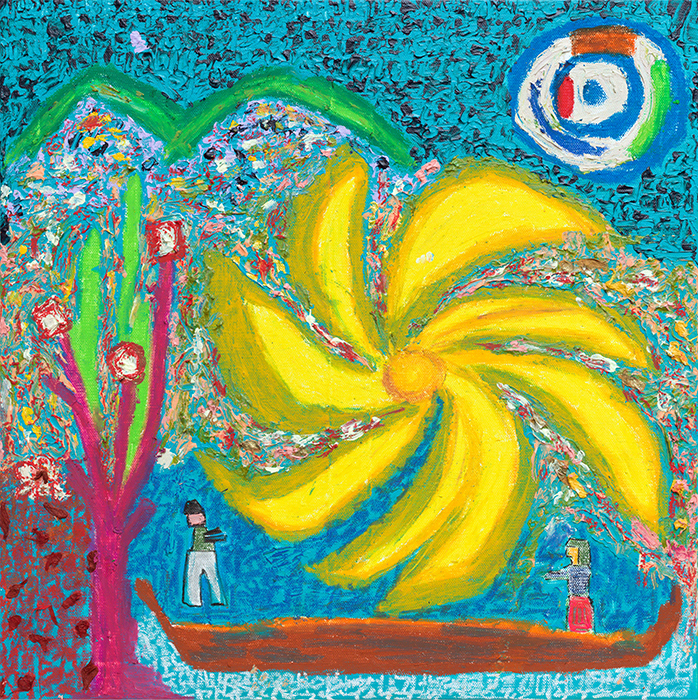
그림일기1.
45x45cm,캔버스에 아크릴,2023

Nicolas de Staël, a painter from Russia,
painted forms without form. Staël expressed his inner psychological state and
emotions by conveying them to the external world he observed. However, the
subjects in his paintings were represented without concrete descriptions, using
only color, with their forms' outlines greatly simplified, whether it was the
sea, a house, or even a person. Despite the high level of abstraction in his
paintings, the depicted subjects feel close and tangible.
He pursued a form of lyrical abstraction known as Art Informel and achieved a
perfect balance between abstraction and representation, becoming a
representative painter of European abstract art. Born in 1914, he quickly
gained fame after his first invited exhibition at the Salon des Indépendants in
1945. But it was from 1951 that he truly made his mark. While residing in
Antibes in southern France, he began to produce remarkable paintings, earning
international recognition centered around the French art scene. However,
critics and art historians of the time harshly criticized his work. Staël, who
was sensitive and delicate in contrast to the bold energy of his paintings,
couldn't endure their criticism and eventually fell into depression and
insomnia. On March 16, 1955, under the blazing Mediterranean sun in Antibes, he
tragically took his own life. Before his death, he left a note that read:
"I no longer have the strength to complete
my paintings."
Nicolas de Staël. Imagining the paintings
he intended but never completed, and recalling Antibes, where he spent his
final days, I created this painting.